In Loschental, near St. Paul in Carinthia, southern Austria, the Weingut vlg. Ritter produces a range of wines including Sauvignon Blanc, Chardonnay, Pinot Noir and other varieties, with new organic grapes set to follow. The award-winning wines of Sabine David are widely regarded as forward-looking and are helping to shape the future of Carinthian wine.
Carinthian wine enjoys considerable recognition, often more so abroad than at home. This is surprising given that Carinthia is historically Austria’s oldest wine-growing region, offering particularly compelling climatic and geological conditions. Loschental, located in the Lavant Valley near St. Paul, lies at the heart of this tradition: it is part of Carinthia in southern Austria and represents the country’s oldest viticultural area.
“We have excellent conditions for wine production and several outstanding producers,” Sabine David explains. “Yet people in Carinthia sometimes still struggle to fully appreciate the value of wine from their own region.” Trained as a mechanical engineer, David entered winemaking as a career changer in 2010, initially cultivating a small vineyard as a hobby. The decisive step toward professional production came in 2012 with the purchase of the traditional farm known as vulgo Ritter in St. Paul im Lavanttal.
“Ritter,” meaning knight in German, is the historic Austrian name of the estate – an identity rooted in local tradition and still closely tied to the character of the winery today.
At present, four vineyards extend across two hectares, each defined by distinct soil profiles—a particularly intriguing aspect for wine connoisseurs. “I work with limestone soils, primary rock, and even up to two metres of clay sitting on a karst base,” says David, describing a combination that is unusual for Carinthia. “I find it fascinating to observe how different soils shape the character of the wines. Limestone-grown wines are typically lean and mineral,” she continues, referencing France’s Champagne region as the world’s most famous limestone terroir. “Clay is heavy, and the wines are broader and more powerful. Clay brings weight, while limestone delivers elegance and finesse.” These contrasts can be experienced directly during tastings, where guests sample three Chardonnays from three different vineyard sites, each defined by its soil type. The differences are unmistakable.
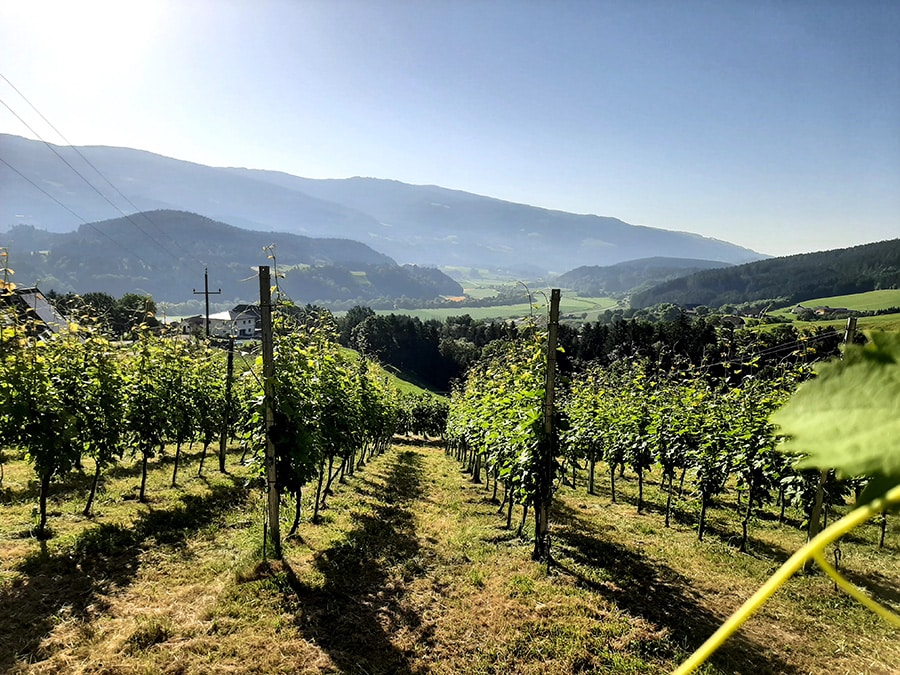
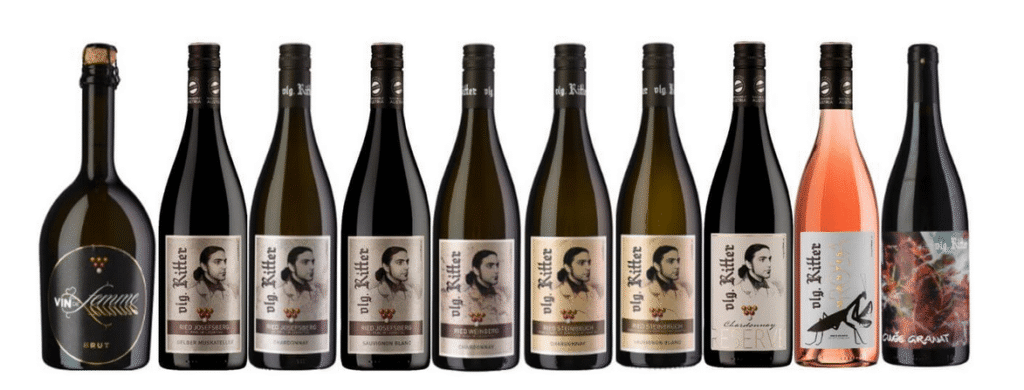
Alongside Sauvignon Blanc, Chardonnay, Muskateller, Pinot Noir, Rotburger and Blauburger, new grape varieties will soon enter production. A newly planted vineyard is farmed organically, without chemical plant protection. Here, Souvignier Gris is growing, but the focus lies on Satin Noir and Cabernet Cortis, which are intended to form a future cuvée. Family life is closely interwoven with the estate: the couple’s three children, still of kindergarten and primary school age, already help out enthusiastically in the vineyards. David’s husband, Dominique, has recently taken up craft brewing as a hobby. The estate also offers tastings in an idyllic farm setting, with the beers now available for purchase as well. In addition, the property serves as a venue for weddings, corporate events and private celebrations.
The wines of Weingut vlg. Ritter are highly regarded in Austrian gastronomy and hospitality, as well as by private customers, and are exported as far as the United States. Annual production amounts to around 10,000 bottles. The now well-known label features an illustration showing Dominique himself; its distinctive artistic style appears to give form to the “Ritter”.
Each year, the wines receive multiple international gold and silver awards. In addition, Sabine David has expanded the range to include vermouth. “For a long time, it was considered old-fashioned, but it has made a strong comeback as a long drink or as an aperitif,” she explains. “We serve it, for example, with tonic, and it’s extremely well received. We have everything we need right here: the wine, the grape spirit we produce ourselves, and the herbs from our own garden.” The estate’s first sparkling wine, Vin de Femme, produced in collaboration with fellow winemaker and farmer Martina Lippitz, has also enjoyed great success.
Last summer, David operated a pop-up vinotheque at Lake Klopeiner See together with fellow winemakers from Klagenfurt, the first of its kind, featuring exclusively Carinthian wines. “Wine lovers and gastronomy professionals came from all over Austria. Many told us they had heard a lot about Carinthian wine but had no idea where to find it.” Stronger word-of-mouth, better marketing and a reputation that truly reflects the quality of local wines are still in the making, says the Lavant Valley winemaker, who is working closely with her colleagues toward that goal. “The best advice I can give is to visit the winemakers directly, taste the wines on site, and experience the region’s true potential for yourself.”