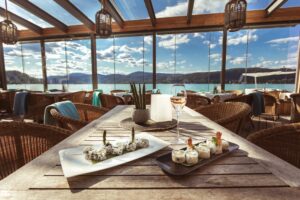
Michael Sicher runs the family business “Sicher,” widely regarded as the finest fish destination in southern Austria. Fish have been raised here for more than 60 years. His gently harvested char caviar has earned international attention; equally compelling are his use of the Japanese ikejime killing technique and a winter menu full of surprises. Stages of Taste met the chef and fish farmer.

Hidden in idyllic countryside near the River Drau, in the South Carinthian village of Tainach, regional fine dining sets the tone. This is where brothers Michael and Wolfgang Sicher run their family business, considered by chefs and guests alike to be Carinthia’s undisputed number one address for fish. What makes it special: every fish comes from the restaurant’s own ponds, and even the most exotic-looking herbs are grown in the garden. For its exceptional commitment to regional sourcing, the restaurant was awarded the Michelin Green Star last year.
Around 60 years ago, Alfons and Erna Sicher established the guesthouse and, shortly after, the fish farm at the family’s historic sawmill. Today, 24 ponds are home to various species of char, trout, and sturgeon. Michael Sicher tends to his fish with remarkable dedication. “I allow myself the luxury of giving the fish the time they need to grow,” he says. Fed by a nearby stream carrying fresh spring water, the fish also have plenty of space – “more than organic regulations would require,” explains the fish expert. But that is far from the only distinguishing feature.
“I’m personally not a fan of net fishing. For me, stress-free killing is the top priority. That’s why we work with the Japanese ikejime technique.” And not only for ethical reasons. As with mammals, the killing process and the release of stress hormones have a direct impact on meat quality. The Japanese method involves catching the fish without stress, followed by a precise spike to the brain and a specific incision along the spinal cord. A practical advantage when the fish are raised in one’s own ponds. “I have the luxury of being able to control quality myself,” says Sicher. It is this quality that has become known far beyond Carinthia’s borders.
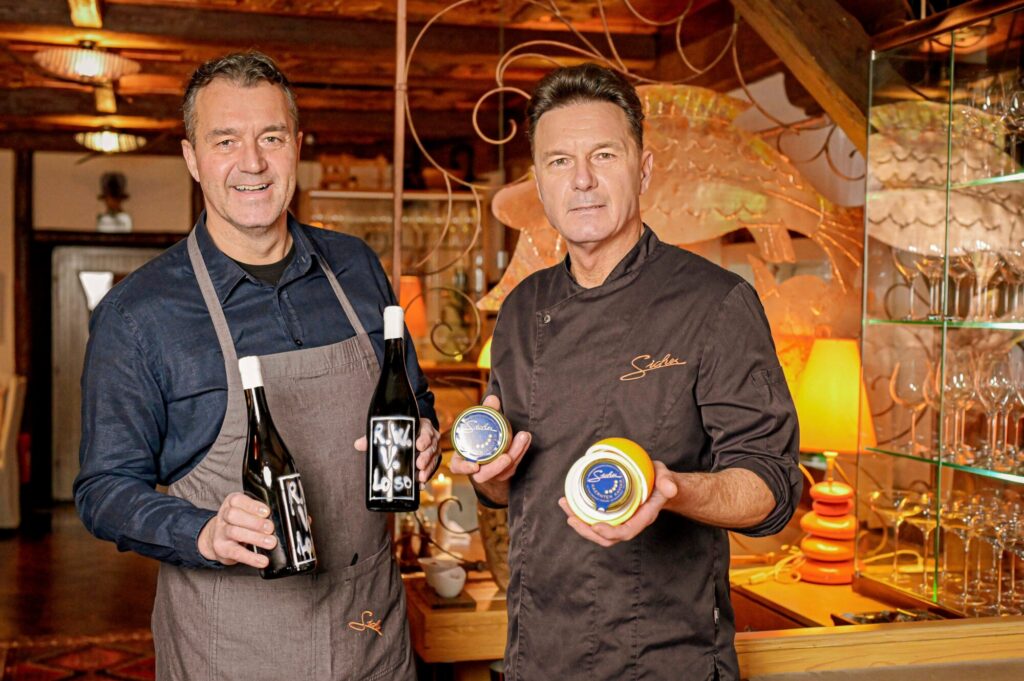
The char caviar is the flagship product of the business and considered a true delicacy. “We harvest the char caviar very gently,” explains Michael Sicher, who here too pays close attention to farming and production conditions to ensure the highest possible quality. Unlike industrial caviar production, the fish are neither killed nor injured. Instead, the eggs are extracted through gentle pressure, allowing the fish to return to the cold spring water shortly afterwards. The glowing orange pearls are not easy to come by, however. “The yield is small—we have to supply our regular customers,” says the host, who supplies Michelin-starred chefs well beyond Austria’s borders. Still, he lets slip one secret: “You can buy the caviar at Rumpel Delikatessen in Vienna’s Hietzing district!”
The char remains the bestseller for good reason. “I could never take the char carpaccio with char caviar off the menu. Some guests come here specifically for that dish.” That international fish dishes – take the perennial Peruvian trend dish ceviche – work beautifully with local ingredients is something Sicher’s creations demonstrate year-round. Alongside various fish from the ponds, the winter version of ceviche features beetroot. “I use different types of fish, combined with smoked sour cream and Mexican giant marigold,” he explains. The latter, of course, is not an imported ingredient. The aromatic citrus herb is just one of many plants thriving in the restaurant’s own garden – alongside five varieties of coriander, goji berries, kiwis, hazelnuts, yams, and countless other herbs, fruits, berries, and rarities that flourish remarkably well in Carinthia’s climate. Sicher is particularly enthusiastic about the deep-red “blood apple” from his garden, which he prepares in various ways – currently as a dessert with quark.
Beaver on the Sicher Winter Menu
Fish takes center stage in the tasting menus and à la carte offerings alike, unfolding into a creative play of flavors inspired by cuisines from around the world. When meat does appear on the menu, it does so deliberately and with restraint, in keeping with the restaurant’s regional philosophy. In the colder months, this might mean venison as a main course, paired with amaranth, plum and Topinambur. Or: beaver ravioli.
What caused quite a stir in the media last year—sparked by Burgenland’s outspoken chef Max Stiegl—has since settled down somewhat. Or, as Michael Sicher puts it: “It has arrived in people’s minds.” Namely, the idea that what may be legally hunted should also be processed and used. Since the introduction of Carinthia’s new “beaver regulation” in 2025, up to 148 beavers may be culled annually in cases of damage and to slow their spread. A circumstance that, if you will, opens up new culinary possibilities. “In terms of texture, the meat probably comes closest to venison, though it has a character all of its own,” says Sicher. He braises the meat before turning it into a filling for ravioli, which are then served with porcini purée and a soft-cooked quail egg.
Beyond that, winter gives the stage to produce from the restaurant’s own garden—celeriac, carrots, pumpkin, kiwi and hazelnuts among them—joining the various fish dishes in a colorful, wintry dance.
No Calamari?
Fish remains the undisputed focus here, in all its forms—from classic à la carte dishes to a fully fledged, creative seven-course menu with wine pairings curated by younger brother Wolfgang Sicher. That the term “fish restaurant” is sometimes underestimated is taken with good humor. “It does happen that tourists sit down and say, ‘What kind of fish restaurant is this—you don’t even have calamari,’” Sicher laughs. “They usually end up going somewhere else on their own.”